elven exclusion laws
The Ballad of the Last DragonElven exclusion laws are the institutional machinery through which anti-elf prejudice becomes everyday governance. They do not merely express suspicion of elves; they translate old stories, unequal testimony, property seizure, surveillance, curfews, and licensed violence into a social order in which elves remain subject to power while being denied its protections. Their decisive significance lies in the way they transform a contested history into material dispossession: land ceases to be home, memory becomes the substitute for archives, and survival requires concealment, flight, or resistance.
Historical Origins and Manufactured Fear
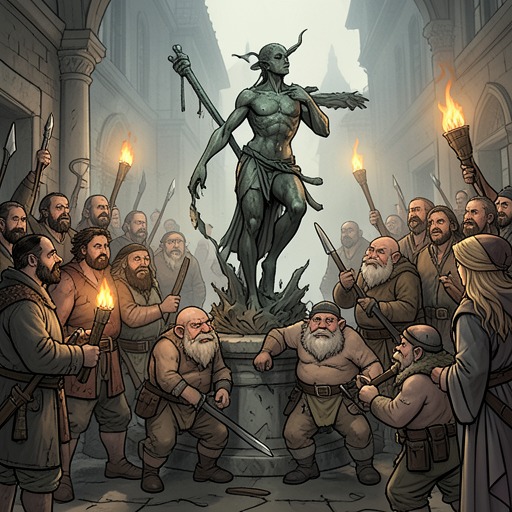
The laws grow out of the aftermath of The Unification, known among elves as The Great Loss. Human and dwarven histories preserve a heroic account in which humans and the dwarves who allied with them defeated the ancient elves, presenting those elves as beings of power and malice. Dwarves who took up arms were rewarded with land and minor titles in Targgein, while elven texts and sacred structures were destroyed. The destruction was not only physical. Because written records were lost, elven history survived primarily through spoken transmission, making Sylvaine Abelan’s father’s teaching of the ancient elven alphabet and their history an act of cultural defiance.
For more than a century, an uneasy peace concealed the accumulation of distrust. Stories claimed that elves could control human thoughts through their voices or drink the blood of human children, although the narrative presents these beliefs as absurd fabrications rather than evidence of actual elven power. Rationality temporarily restrained the fear, but repeated suspicion made violence politically possible. The laws therefore emerge from a long process in which myth is treated as a public danger and prejudice is recast as prudence.
Political and Property Restrictions
One of the earliest practical mechanisms of exclusion appears in local governance. Land disputes are decided in favor of humans because town magistrates accept a human’s word over an elf’s, while elves are forbidden to speak in official councils on the pretext that their voices might possess magical influence. The rule removes elves from the institutions that determine their rights, then treats their absence from those institutions as confirmation that they have no legitimate standing.
The restrictions intensify when accusations become normalized. A human can claim that an elf used magic to compel intimacy or manipulate a bargain, turning ordinary disagreement into proof of supernatural wrongdoing. Once such accusations gain social authority, elves are denied the presumption of credibility: their testimony is inherently suspect, while the allegation against them is treated as self-validating.
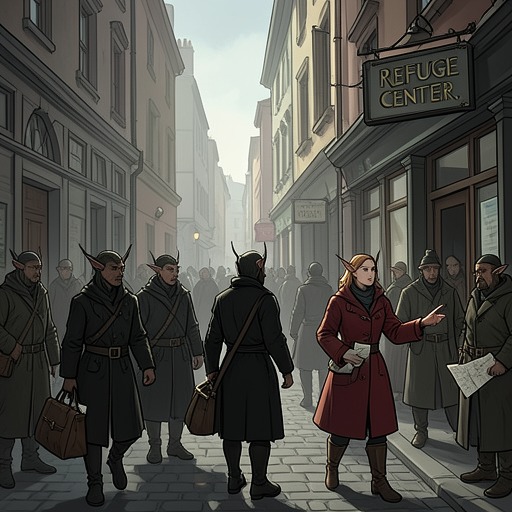
The raids follow this legal and rhetorical preparation. Elves lose the right to hold titles, including titles to land. Those who refuse to surrender their property and move into cities, where searches and curfews govern their movements, are branded fugitives. The law thus converts ownership into an offense and resistance to dispossession into criminality. It also gives local authorities and private citizens a direct financial interest in enforcing the system: humans may pay a taxation fee to obtain a license to hunt fugitive elves for sport. Some hunters wear severed elven ears on chains as trophies, making the body itself a public record of the law’s violence.
Displacement, Surveillance, and Everyday Threat
The legal assault destroys the relationship between elves and the land. Elves are tied to places through memory and generations of ancestors, but once those places can be confiscated and defended against them, inherited belonging becomes dangerous evidence rather than protection. Those who can afford escape leave for safer shores, though transport is scarce and expensive. Sylvaine Abelan can afford only one boarding pass, forcing her to leave her parents behind while knowing that imprisonment or worse may await them.
The effects continue beyond the territory where the restrictions are most blatant. In Hawthok, a dwarven barkeep can move through tavern life with an easy air of camaraderie, partly because of the old Hawthokian alliance with humans. An elven barkeep, by contrast, would likely face tension and vaguely hostile threats from rowdy drinkers. The contrast shows that exclusion is not simply a matter of formal statutes; it is reproduced through collective memory, racialized expectation, and the uneven social legitimacy granted to different peoples.
Sylvaine’s daily precautions reveal how the law survives as anticipated violence. She checks her cap before every performance to ensure that her ears are covered, because she cannot know how far the inherited fear has traveled or when it may erupt. On one occasion, a tavern patron grabs her and calls her a knife-ear, telling her that she is lucky to be allowed inside and ordering her to fetch drinks. The insult is accompanied by the threat of physical punishment, while her body responds with numb legs, a tightening throat, dizziness, and the onset of panic. The episode demonstrates how exclusion makes ordinary public participation conditional: performance, travel, and even entering an inn require constant calculation of whether her identity will be noticed.
Violence, Resistance, and Ethical Refusal
The laws produce a world in which Sylvaine cannot safely be alone with unfamiliar men. When three rowdy tavern patrons approach her in a field at night, she climbs into a concealed branch rather than risk being seen, carrying both the short sword Neith insisted she take and a shepherd’s sling. Her vigilance is not presented as irrational paranoia but as a learned response to a society that has made elven bodies available to suspicion, pursuit, and assault.
When the threat is finally reversed and one attacker kneels before her, Sylvaine has the power to place fear in another person’s heart. She holds the blade at his pulse and nearly drives it into his belly, confronting the possibility of killing him as a form of recovered agency. Yet she stops. She does not want his blood on her hands or his death as a permanent companion. Her declaration that she is not human and does not want to be is not an embrace of the exclusionary hierarchy; it is a refusal to become the kind of human violence that has defined her oppression. The moment distinguishes resistance from imitation. The laws have taught her fear, but they do not finally determine what she will do with power.
The narrative also places legal reform beside personal retaliation. Jaromir explains that his nominal betrothal to Rhosyn exists to protect her claim to the family home after Damir’s death. Under Kalinia’s male-heir inheritance regime, the property may pass to Jaromir and, if he dies without heirs, to the town magistrate, leaving Rhosyn and her daughters vulnerable to eviction. Rhosyn makes clear that she has no interest in marrying Jaromir for love; she wants to preserve the house Damir built, where the traces of his labor remain part of her daughters’ lives. This parallel shows how exclusionary legal structures operate across ethnic and familial lines, assigning security to approved heirs and exposing those outside the preferred category to dispossession.
Reform and Continuing Counterforces
The response to exclusion eventually moves from survival to institutional challenge. After Rhosyn’s repeated petitions fail, Sylvaine helps confront Magistrate Ridion directly. She verifies the situation with Rhosyn, prepares a legislative document, and uses the threat of public performance to compel action. Rhosyn demands that Kalinia discard its antiquated inheritance law, prevent people from being thrown out of their homes after family tragedy, and adopt Queen Dhara’s inclusive land and title policies so that any person can create a life there. Sylvaine’s art becomes political leverage: the magistrate is threatened not with private violence but with the public story her song could make of his conduct.
This reform does not erase the broader history of elven exclusion, but it supplies an alternative to a system that treats vulnerability as an opportunity for seizure. The contrast between the magistrate’s ornate desk and the filthy boots Sylvaine deliberately places upon it captures the collision between administrative privilege and those forced to negotiate survival at its threshold. The scene also establishes that laws can be contested from within the public sphere once excluded people gain an ally willing to make their grievance audible.
Other counterforces appear through practical solidarity. When Sylvaine learns that a vessel is rescuing elves, she asks what price is being charged for transport and experiences relief when told that the refugees are carried for nothing. That refusal to profit from people escaping death and dismemberment stands against the economic logic of the hunting licenses and scarce passage that made her own departure so costly. In this sense, the story answers exclusion not only with legal amendment but with acts of unbought assistance.
Elven exclusion laws remain one of the narrative’s central structures of historical violence. They connect destroyed archives, forbidden speech, confiscated land, curfews, public stereotypes, bodily trophies, panic, migration, and the fear of being recognized. Yet the same structure clarifies the importance of memory, chosen mercy, public testimony, and reform. Sylvaine’s survival is not a clean escape from the laws’ consequences; it is an ongoing refusal to let those laws define her humanity, her relationships, or the possibility of a home.